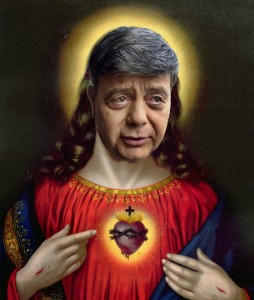

Roy Cohn Ikon Matte Canvas, Stretched, 1.25"


Roy Marcus Cohn was a historic personage, a neoconservative lawyer who played a pivotal background role in Republican politics in his three decade career. I decided to use a historical photo of Cohn for obvious reasons.
Cohn as a character serves as a rebuttal and response to Shylock and The Merchant of Venice’s pronounced antisemitism. Kushner has been vocal about how he found himself bizarrely moved to sympathize with Cohn owing to the homophobia expressed by Progressive publications like The Nation, whose obituary was especially vicious. As the villain he journeys through his own unique arc where audiences cannot help but feel some level of sympathy for his miserable fate as a result of contracting the virus. He is nevertheless unrepentant and despicable until his final moments. He stands in the most despicable position in the Spectrum of Villainy, with his hard-right politics being intertwined with his closeted lifestyle.
I have never seen a live performance of the play but have watched three recordings featuring different casts. Ron Liebman’s performance was electrifying, Al Pacino’s subdued, and Nathan Lane was hammy in a manner suggesting Cohn was a screaming queen rather than a closet case. I found that rendition particularly offensive because Cohn was so opposite of femme. His closeted demeanor was always a sick and bizarre combination of homophobic machismo fused with concontaminant homoerotic subtext. He brought together a posture of tough-as-nails ruthlessness with an unveiled daintiness.
Tony Kushner's classic play Angels in America is one of the most revered theatrical works in the past half-century. The story of two couples falling in and out of love during the AIDS epidemic of the 1980s, the play examines sexual liberation, love, and responsibility at the dawn of the neoliberal epoch.
But what happens if we reconsider the play using an Orthodox Christian aesthetic of representation, creating icons to represent the characters and their journeys during the play? Author Andie Stewart has brought together years of study in order to create character portraits unlike any other.
-Michael Meeropol, older son of Julius and Ethel Rosenberg (the latter of whom is portrayed in the play)
The frame is made with profile radiata pine that is ethically sourced from renewable forests.
.: Materials: cotton and polyester composite (canvas), pine wood (frame)
.: Comes in 60 different sizes (including vertical and horizontal orientations)
.: Horizontal, vertical and square options available
.: Soft rubber dots on bottom back corners for support
.: Back hanging included
.: Inner frame made with radiata pine sourced from renewable forests
.: Please note: Due to the production process of the canvases, please allow for slight size deviations with a tolerance +/- 1/8" (3.2mm)
| 9" x 12" (Vertical) | 11″ x 14″ (Vertical) | |
|---|---|---|
| Width, in | 9.00 | 11.00 |
| Height, in | 12.00 | 14.00 |
| Depth, in | 1.25 | 1.25 |

Unique coating
JONDO uses a unique canvas coating that produces the highest quality images using UL-certified Greenguard Gold inks

Sustainable product
The canvas prints are stretched on our proprietary profile radial pine produced from use wood from FSC certified renewable forests

Latex inks
Canvas are printed using latex inks that are non-hazardous, non-toxic, non-flammable

2 rubber dots
Rubber dots on the bottom of canvas ensures the canvas stays in place when hung
If the canvas does gather any dust, you may wipe it off gently with a clean, damp cloth..
Accurate shipping options will be available in checkout after entering your full address.
Any goods purchased can only be returned in accordance with the Terms and Conditions and Returns Policy.
We want to make sure that you are satisfied with your order and we are committed to making things right in case of any issues. We will provide a solution in cases of any defects if you contact us within 30 days of receiving your order.
See terms and conditions